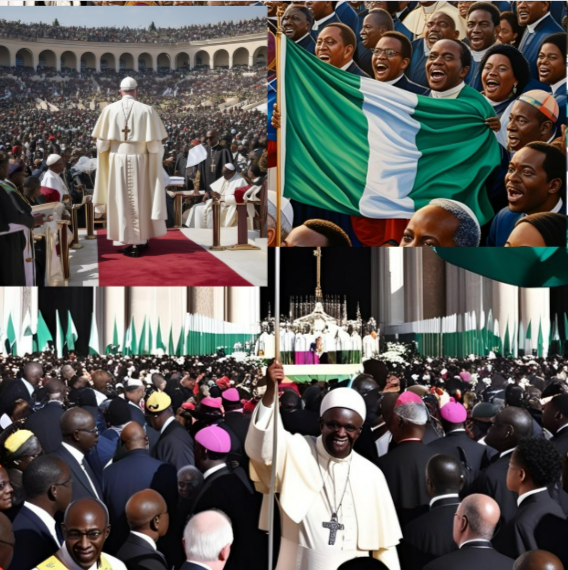
President Bola Tinubu’s attendance at the inauguration of Pope Leo XIV as Nigeria’s Muslim head of state raises some important questions about religious inclusivity and the political symbolism at play. While some might see his presence as a sign of interfaith unity, it also highlights a significant contradiction in Nigeria’s political scene—especially considering he was elected on a Muslim-Muslim ticket that heavily relied on religious mobilization in the North.

The political landscape in Nigeria is still deeply divided along sectarian lines. The North, which has long pushed for faith-aligned leadership as a reflection of its demographic identity, now finds itself in a rather ironic situation: a Southern Muslim president comfortably attending a major Christian event, while it’s hard to imagine a Northern Muslim president doing the same without sending a Christian representative, like the Vice President or another high-ranking official, in his place. This double standard reveals a troubling trend—religion is often used as a tool for electoral success but is overlooked when it no longer serves immediate political needs.
The real issue here isn’t Tinubu’s personal beliefs or his right to engage in interfaith diplomacy; it’s the broader hypocrisy of Nigeria’s political elite. They leverage religious identities to gain power but fail to ensure fair representation in governance. True leadership should rise above sectarian divides, making sure that all regions and faiths feel genuinely included—not just given token gestures. If Nigeria hopes to move past divisive politics, its leaders need to consistently apply principles of fairness and inclusivity, rather than doing so selectively.
The ruling party’s choice to run a Muslim-Muslim ticket—pairing a Southern Muslim President with a Northern Muslim Vice President—was a strategic attempt to secure votes from the North. However, this decision has left both regions feeling disillusioned, highlighting the ticket’s failure to address the country’s diverse needs. Tinubu’s presence at a prominent Christian event, especially when many Muslim-majority countries chose to stay away, underscores this hypocrisy. If the ticket had been Christian-Christian, it’s hard to imagine the President attending an Islamic event without sending a senior Muslim official, which points to a clear imbalance in religious sensitivity.
This strategy not only jeopardizes national unity but also shows a fundamental misunderstanding of Nigeria’s rich diversity. A government that claims to represent all Nigerians needs to go beyond mere tokenism and actively work to ensure that no faith or region feels sidelined. The APC’s religiously uniform ticket sets a troubling precedent, endangering the fragile social cohesion that Nigeria’s democracy relies on.
Nigeria’s leaders must stop using religious identities as tools for political advantage and instead adopt a governance style that genuinely reflects the nation’s diversity. The Tinubu administration’s actions—whether attending religious events or making policy choices—should be examined through the lens of fairness, rather than political convenience. Only by genuinely prioritizing inclusivity can Nigeria hope to mend its divisions and create a future where every citizen, regardless of their faith or region, feels valued and represented.
About the Author